
On April 25, 2026, the Manlius Historical Society, along with the Bureau County Historical Society, hosted a presentation on the New Bedford Elites Fastpitch Softball team founded by Earl Stickel.
By Jim Dunn, President, Bureau County History Center Board
Iowa has its Field of Dreams. Illinois has its Bollman Memorial Field. Both were built in the middle of nowhere. One was featured in a Hollywood movie, attracted ghostly players, and inspired millions of baseball enthusiasts. The other, named after a promising young man who died too soon, is but a distant memory preserved in three-ring binders at the Manlius Historical Society.
But for aging fast-pitch softball fans, what a memory it is!
Seven decades ago, tiny New Bedford, population 98 in northwestern Bureau County, was arguably the fast-pitch softball capital of Illinois and, some might say, the nation as well. That’s because a 60-something businessman named Earl Stickel, a native of Davenport, Iowa, got hooked on watching fast-pitch softball. Stickel liked it so much that he sponsored a local amateur softball team called the Bollman Oil Elites, also known as the New Bedford Elites, and entered it in the International Softball League’s World Softball Tournament in Texas in 1952. After that, Stickel decided to spend big bucks to build a 5,000-seat softball stadium in New Bedford and name it after his long-deceased first cousin.
Vivian Bollman’s Story
Had he lived, Charles Vivian Bollman, who was five years younger than Earl, likely would have inherited the oil company owned by his father, Fred C. Bollman.
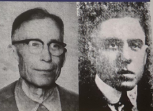
Left: Earl Stickel (1893-1975) built Bollman Memorial Field in New Bedford, Illinois, in honor of his deceased first cousin, Vivian Bollman. Right: Charles Vivian Bollman was 19 when he died in the 1918 flu epidemic.
Even at a young age, Vivian, as he liked to be called, showed a flair for business. For example, in his late teens, he was already involved in his father’s Ford automobile agency in Princeton.
Sadly, Vivian caught the flu in the 1918 epidemic and died. He was 19 years old. His final resting place is Oakland Cemetery, Princeton.
With his only son dead, Vivian’s father decided to bequeath his business, Bollman Oil Company of Manlius, to his nephew, Earl. Over the years, Stickel grew the business and made a lot of money, but he never forgot his uncle’s generosity or the fact that he had benefited from Vivian’s untimely death.
Decades later, Stickel remembered Vivian Bollman when the time came to name his amazing softball field.
Bollman Memorial Field, built on the edge of New Bedford, opened on June 1, 1953. Over the next eight years, it became the site for an amazing array of exciting softball games.
The softball park cost Stickel an estimated $40,000 to construct, which in today’s money would be more than $450,000. But he gladly paid it and put forth additional money to cover the team’s expenses.
March Toward Greatness
The Elites’ march toward greatness had just begun. Made up of players from Bureau, Whiteside and Rock Island counties, the Elites played numerous regional teams in Illinois and nearby states.
In 1953, they placed second in the Illinois State Tournament, but failed to advance in games they played at the World Tournament.
In 1954, the Elites won the State Tournament and were awarded the Pepsi-Cola Trophy and again advanced to the World Tournament.
Hugh Skinner, sports editor of the Bureau County Republican, recognized the team’s accomplishments:
“The sports desk congratulates E.C. Stickel and members of the Bollman Oil Elites softball team for winning the International Softball League state tournament. … I am sure I can speak for all the ball fans in the area in wishing them the best of luck next week in Selma, Calif., Fresno County.”
It was tough going for the Elites in the 1954 World Tourney, as they again failed to advance.
Stickel, the team’s owner, must have thought a home-field advantage would help his Elites. He submitted a bid to host the 1955 World Softball Tournament and put up a $9,000 guarantee of profits from gate receipts. He got the volunteer fire departments in New Bedford and Manlius to assist with the sponsorship.
Surprisingly, his bid was accepted. Thus, 17 teams from as far away as Arizona, Utah, Texas, Indiana, Ohio and California converged on Bollman Memorial Field in tiny New Bedford for the nine-day event, lodging in motels and hotels in Sterling, Rock Falls and Princeton.
Thousands of softball fans also converged on New Bedford.
“It was almost like ‘Field of Dreams.’ Every evening, a line of cars came in to fill up the park,” recalled Milt Stark, executive director of the International Softball Congress, in a 1998 Chicago Tribune article.
Welcome to New Bedford
In the 1955 program, Stickel welcomed visitors to Bollman Memorial Field, and he thanked the International Softball League, its officers, team sponsors, players, the Sterling Chamber of Commerce, merchants and volunteers for their cooperation.
“In accepting the sponsorship of this tournament, we do so with the feeling that this event is in keeping with our policy of promoting wholesome recreation and entertainment for both players and spectators alike,” Stickel stated.
The event was so successful that New Bedford hosted it again in 1956 and 1957.
So, how did the Elites do with their home-field advantage?
In 1955, the Elites placed third in the nation, losing to Dinuba, California, in the final game. They closed out the season with 62 wins and 7 losses.
In 1956, they again placed third in the nation.
And in 1957, the Elites finally advanced to the championship game. But capturing the tournament title was not to be for the New Bedford squad. As the BCR sports department’s headline put it on Sept. 6, 1957, “Nighthawks cop 3rd consecutive crown, top Elites, 3-0.”
Elites’ Last Hurrah
That turned out to be the high-water mark for the talented team from New Bedford.
For the next four years, the Elites continued to play regional games in Wisconsin, Illinois and Iowa, and tournaments in Texas.
And they continued their winning ways, finishing the 1960 campaign with a 33–3 record, and the 1961 campaign with a 20–17 record.
“During the past eight years, Elite softball teams have won 352 games while losing only 67, a percentage of .840,” according to a story in the Sept. 14, 1961, issue of the Republican.
The 1961 season turned out to be the Elites’ last hurrah. The team disbanded after expenses got too high and quality players became harder to find.
Bollman Memorial Field has long since been closed. Stickel died in 1975. He was 82 years old. He was buried in Pleasant View Cemetery, Kewanee.
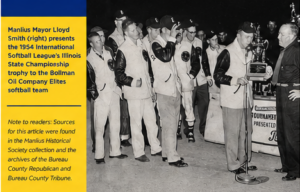
Ghostly ball players never walked out of neighboring cornfields onto Bollman Memorial Field, as they did in the movie Field of Dreams. But for nearly a decade in the 1950s and early 1960s, a similar rural ball diamond paid tribute to the memory of a long-deceased young man whose life was sadly cut short.
For that respectful tribute to his cousin, Earl Stickel deserves profound credit.
Note to Readers
Sources for this article were found in the Manlius Historical Society collection and the archives of the Bureau County Republican and Bureau County Tribune.